
There are journeys that take you to a place, and then there are journeys that become a part of the place itself.
The Nanda Devi Raj Jat (नंदा देवी राजजात / pilgrimage) is one such journey in Uttarakhand. Held once every twelve years, it takes devotees deep into the Himalayan landscape, from villages and forests to high-altitude meadows and some of the most difficult stretches of the mountains. The journey is closely connected with the story of Maa Nanda and her Beti ki Vidai (बेटी की शादी के बाद विदाई) from her maternal home towards Kailash, the home of Lord Shiva.
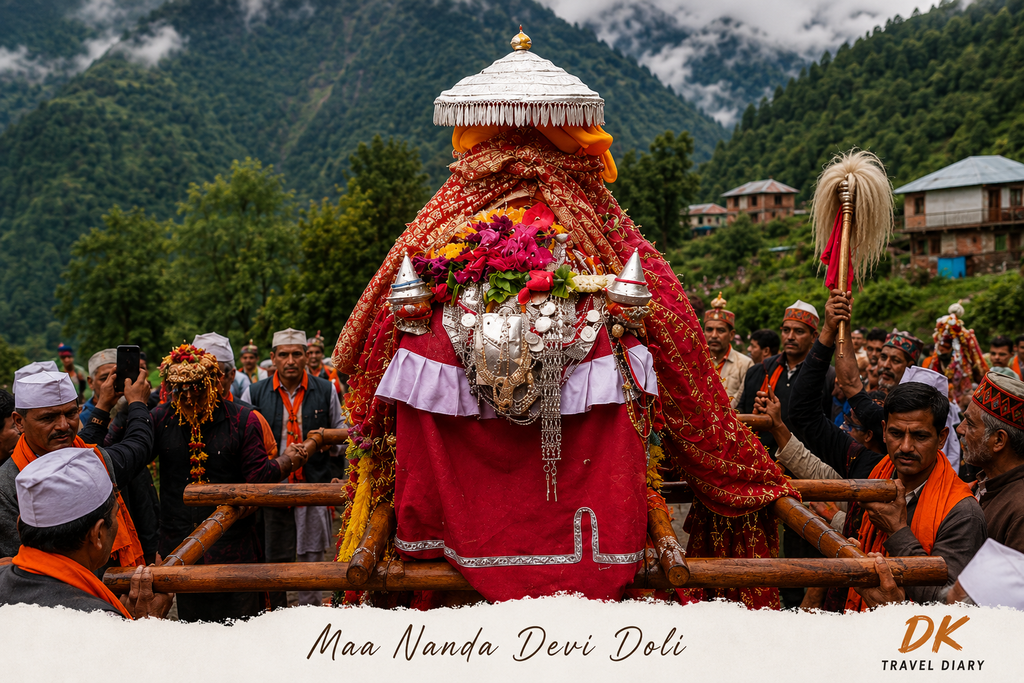
For the people who take part in it, this is not simply a long walk through the mountains. The doli (डोली) of Maa Nanda, traditional songs, village rituals, offerings and the presence of the Chausinghya Khadu (चौसिंघ्या खाड़ू / four-horned ram) all become part of the same story. The route brings together people from different parts of Uttarakhand and carries traditions that have been passed down through generations.
The journey also takes you through a very different side of Uttarakhand Travel. Away from the usual tourist routes, the Raj Jat moves through villages, forests, alpine meadows and high Himalayan passes before reaching Homkund.
This is why the Raj Jat is more than a route on a map. To understand it, you have to look at the relationship between Maa Nanda and her Mayka (मायका / maternal home), her Sasural (ससुराल / marital home), the people who walk with her and the mountains through which this tradition has travelled for generations.
This is the story of the Nanda Devi Raj Jat, its traditions, its route and the people who keep this journey alive.
Who Is Maa Nanda? Her Mayka, Sasural and the Story of Kailash
In the folk traditions of Uttarakhand, Maa Nanda is seen as the daughter of the Himalayas and as a princess who grew up in a royal family. Her Mayka (मायका / maternal home) is remembered as a place of affection, comfort and the warmth of her own people. But after her marriage, her home became Kailash, and Lord Shiva became her husband — the simple Bhole Baba (भोले बाबा) of the mountains.
The world of Shiva is completely different from the royal life associated with Nanda. There is no palace or royal comfort here. Instead, there is a body covered in ash, a garland of snakes around his neck, the trident in his hand and a life far removed from worldly luxury. Yet Maa Nanda is remembered as someone who would still remember her maternal home and the happy days she spent there. Keeping those memories alive and preserving them through generations became an important part of this tradition.
That is why, when the time comes for Nanda to leave her Mayka and return to her Sasural in Kailash, the people of the mountains do not see it simply as the journey of a देवी. They see it as the Beti ki Vidai (बेटी की शादी के बाद विदाई) — a daughter leaving her maternal home for her marital home.
How and Why Did the Nanda Devi Raj Jat B
By now, we have understood that Maa Nanda’s farewell from her maternal home towards her marital home is at the heart of this entire journey. But then another question naturally comes up — how did this tradition begin, and why did it come to be known as the “Raj Jat”?
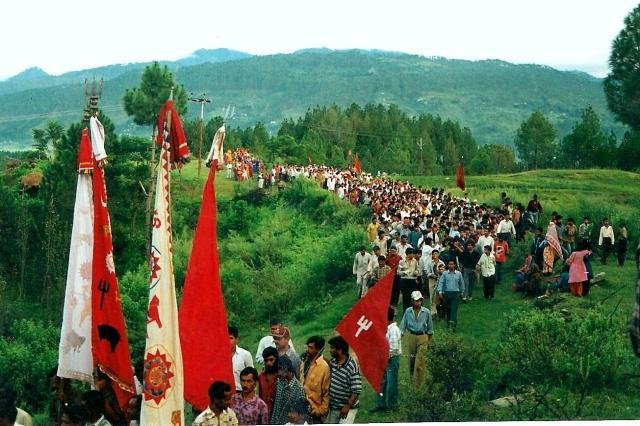
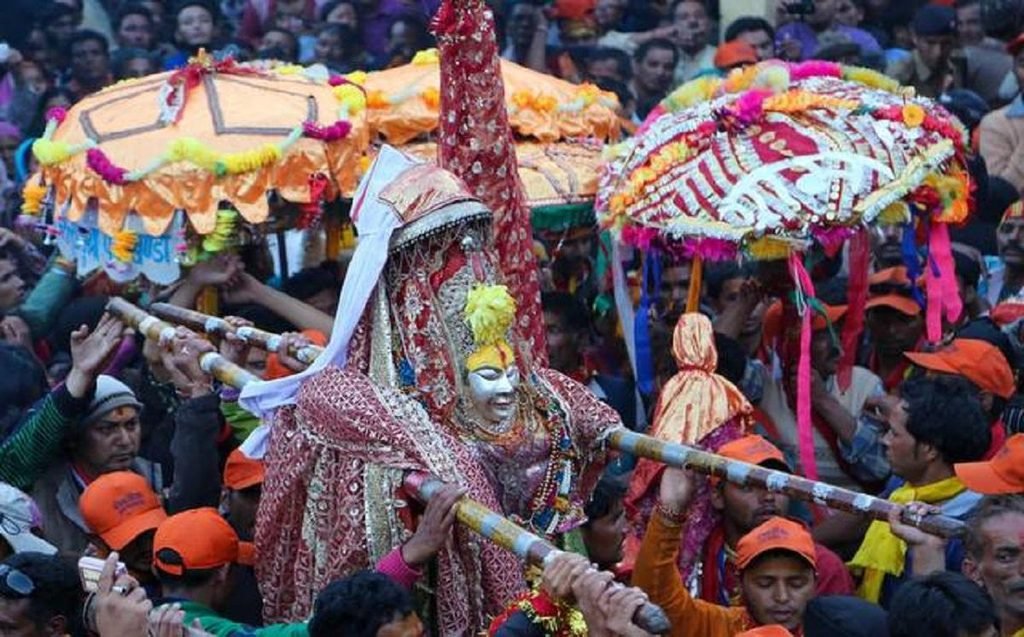
The tradition associated with Nanda Devi has continued for centuries through the villages, royal families and local beliefs of Uttarakhand. Over time, Maa Nanda’s farewell gradually became a large community gathering, bringing together people from different villages, Dev Doliyan (देव डोलियां) and Chantoliyan (छंतोलियां) as part of the journey.
Nauti and Kansuwa hold a special place in this tradition. Nauti is regarded as an important traditional starting point of the Raj Jat, while Kansuwa has remained connected with the royal family and the traditional arrangements associated with the journey.
That is why this cannot be described simply as a religious journey belonging to one village. Over time, it became a tradition in which the legacy of the royal family, the role of the Rajpurohits (राजपुरोहितों), local deity traditions and the faith of ordinary mountain communities all came together.
And perhaps this is where the feeling behind the word “Raj Jat” lies — a journey in which everyone, from the royal tradition to the ordinary people of the villages, comes together to consider Maa Nanda their own daughter and take part in her farewell.
Why Does the Nanda Devi Raj Jat Take Place Only Once Every 12 Years?
One of the most distinctive features of the Nanda Devi Raj Jat is its long duration and the tradition of being held once every twelve years. But this is not simply a matter of following a calendar cycle. Behind it are religious beliefs, shubh muhurat (शुभ मुहूर्त) and traditions that have continued through generations.
In local belief, Maa Nanda is considered a daughter returning to her maternal home. That is why this journey is not seen like an ordinary religious pilgrimage, but as a special Bidaai (विदाई). Just as a daughter returns to her Mayka after many years and then leaves for her Sasural on a special occasion, the same feeling is reflected in the tradition of the Raj Jat.
So when the time for the Raj Jat approaches, preparation does not begin only in one village. Preparations start months in advance. Arrangements are made for the Doliyan (डोलियां) and Chantoliyan (छंतोलियां), while people from different regions prepare to take part in Maa Nanda’s farewell.
The date of the journey is also not decided randomly. The Panchang (पंचांग), auspicious muhurat and religious traditions are taken into consideration while deciding the appropriate time for the Raj Jat.
And in the middle of this entire tradition, another important symbol appears — Chausinghya Khadu (चौसिंघ्या खाड़ू).
It is believed that the birth of a special four-horned ram is considered a sign that the Raj Jat should begin, and that its appearance becomes an auspicious indication for Maa Nanda’s journey ahead.
That is why waiting twelve years is not simply about waiting for time to pass.
It is about preparing for the moment when the mountains once again come together to accompany their daughter towards Kailash.
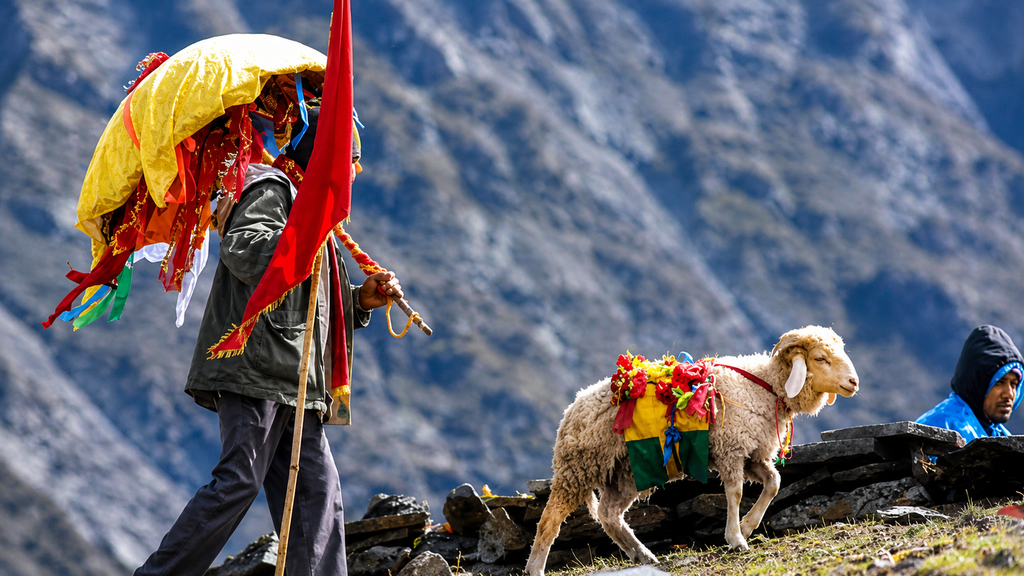
The Guide of the Nanda Devi Raj Jat — Chausinghya Khadu…
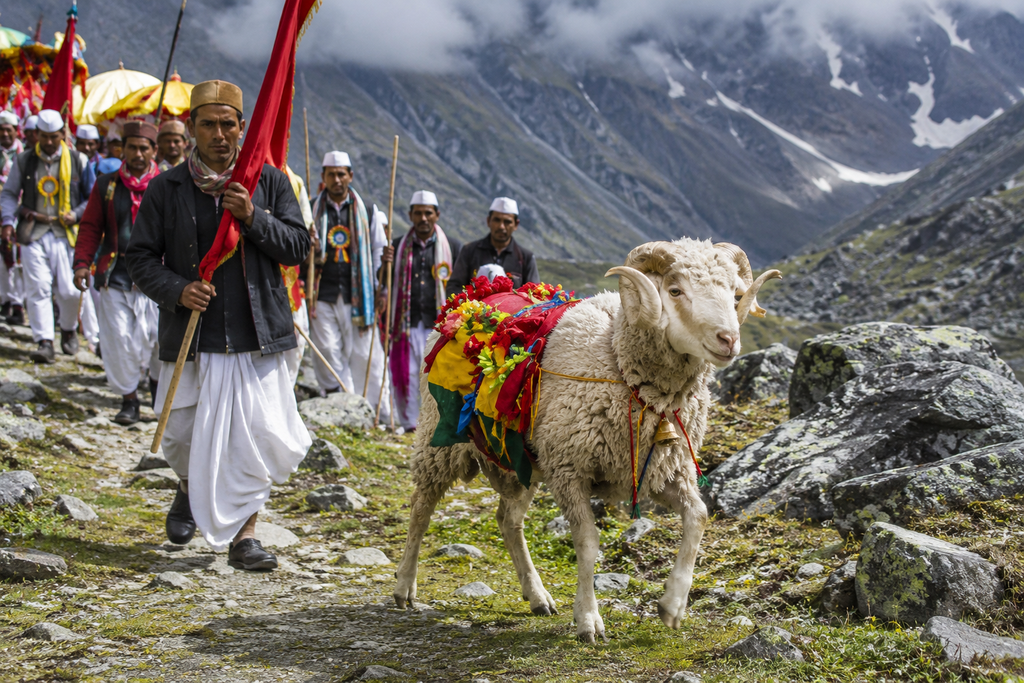
The Chausinghya Khadu (चौसिंघ्या खाड़ू) holds a special place in the Nanda Devi Raj Jat. The four-horned ram is traditionally associated with the beginning of the Raj Jat and is regarded as an important sign for Maa Nanda’s journey towards Kailash.
Its presence is not simply about leading a procession. For the people taking part in the Raj Jat, the Khadu becomes a living part of the journey — moving ahead through villages, forests, meadows and the difficult high-altitude landscape along with the pilgrims.
As the journey moves deeper into the Himalayas, the Chausinghya Khadu remains connected with the traditional rituals and the larger belief surrounding Maa Nanda’s farewell. This is why it is often seen as the pathpradarshak (पथप्रदर्शक / guide) of the Raj Jat.
The sight of the Khadu walking through the mountains, surrounded by pilgrims, flags and traditional Dev Doliyan (देव डोलियां), gives the journey a very different character. It becomes a reminder that this is not only a pilgrimage through the Himalayas, but also a tradition carried forward by generations.
For anyone trying to understand the deeper side of Uttarakhand Travel, the Chausinghya Khadu is one of those traditions that tells you how closely faith, animals, people and the Himalayan landscape are woven together.
Source-based note: The uploaded material specifically supports the association of the Chausinghya Khadu with the beginning of the Raj Jat and its importance within the traditional journey.
Chausinghya Khadu leading the traditional Nanda Devi Raj Jat through the Himalayas
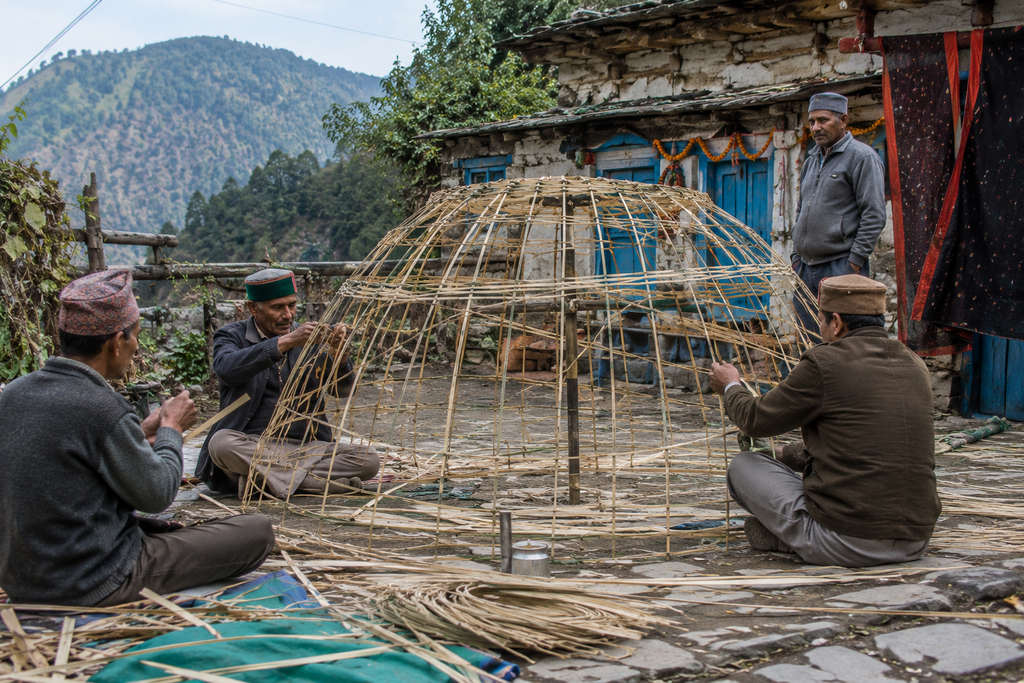
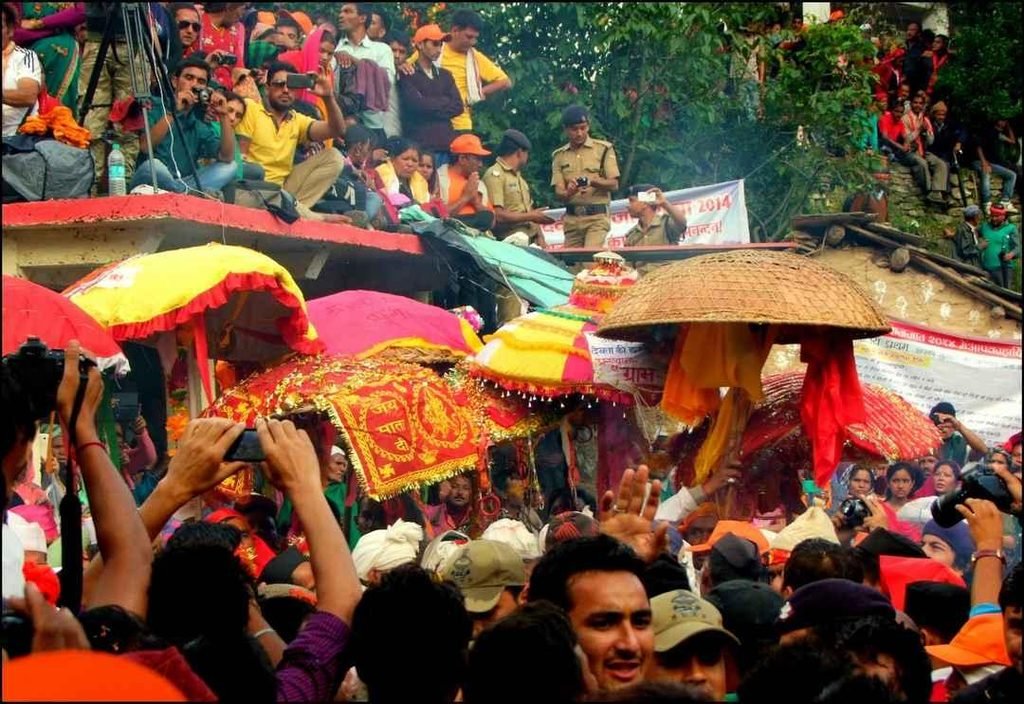
Maa Nanda’s Raj Jat is not accompanied only by the Doli (डोली) and the Chausinghya Khadu (चौसिंघ्या खाड़ू). The journey also includes Chantoliyan (छंतोलियां), each carrying its own colourful decoration and traditional form, making them an important part of the visual identity of the Raj Jat.
You cannot simply understand a Chantoli as an ordinary umbrella and leave it at that. It represents the faith and participation of different traditions and villages. As the Raj Jat moves forward, every Chantoli carries its own identity, customs and local traditions along with it.
According to tradition, the people of Kansuwa village have an important responsibility in preparing the Chantoli. Even in their design and decoration, a clear distinction can be seen. One type of Chantoli is decorated with Bhojpatra (भोजपत्र), which is associated with the Sasural (ससुराल) side, while another is decorated with colourful silk cloth, considered a symbol of the Mayka (मायका) side.
Paswa — Those Believed to Witness the Manifestation of Maa Nanda
The Nanda Devi Raj Jat tradition includes some people whose role may not be immediately understood by someone watching the journey from outside. Paswa (पासवा) is one such role.
According to local belief, during the Raj Jat, Maa Nanda manifests through a Paswa. At different stages of the journey, when this religious belief becomes evident, it is not seen simply as an event connected with an individual. Instead, it is regarded as a manifestation and blessing of Maa Nanda herself.
The role of the Paswa is deeply connected with the faith and traditions of the Raj Jat. Through them, devotees experience the feeling that Maa Nanda is not travelling only in the form of a Doli (डोली) or Chantoli (छंतोली), but is present among her devotees herself.
This is why Paswa hold a special place in the Raj Jat among local people. The traditions associated with them have continued through generations, and their role naturally becomes an important part of each Raj Jat.
To understand the Raj Jat properly, it is important to remember that no individual is simply an individual here. Each one carries a tradition. From the Chausinghya Khadu and Chantoli to the Paswa and the other people who accompany the journey, everyone together becomes part of Maa Nanda’s farewell.
Rajpurohits — The Keepers of Tradition and Auspicious Timing
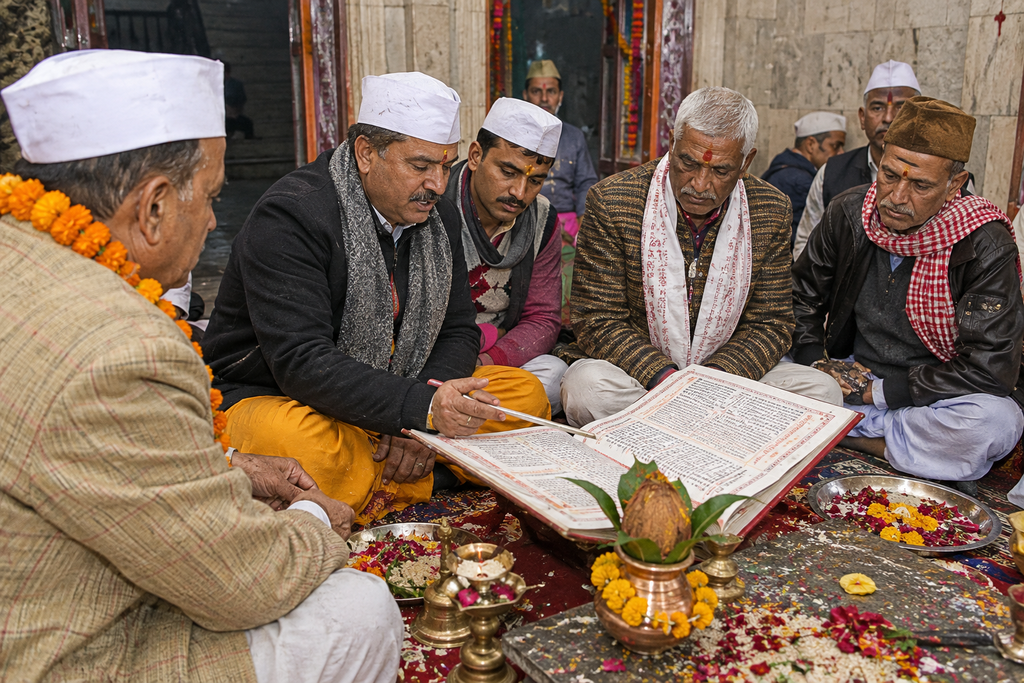
The Nanda Devi Raj Jat is such an old and important tradition that it does not continue on its own. Behind it are responsibilities that families and traditional communities have carried forward for generations. Among them, the Rajpurohits (राजपुरोहित) have an important role, particularly the Rajpurohits associated with Nauti and Kansuwa.
The Rajpurohits have traditionally been connected with the religious procedures of the Raj Jat and with determining the appropriate time for the journey. On occasions such as Basant Panchami (बसंत पंचमी), the Panchang and religious practices are considered while making decisions related to the timing of the journey and its rituals.
Their role is not simply about deciding a date. The different religious ceremonies, traditions and rules connected with the Raj Jat move forward according to established beliefs and practices. In this entire system, the Rajpurohits act as an important link between tradition, religious rituals and timekeeping.
And this is where we understand that the Raj Jat is not simply a pilgrimage in which thousands of people walk together. Behind it is an entire system involving the Raj Parivar (राजपरिवार), Rajpurohits, village communities, Dev traditions and beliefs that have continued for centuries.
The Royal Family and Maa Nanda’s Raj Jat
The place of the Raj Parivar (राजपरिवार) in the story of the Nanda Devi Raj Jat is just as important as that of Nauti, Kansuwa and the other traditional figures associated with the journey. This journey is not seen only as a religious event; it is also connected with the old relationship between the Garhwal royal family and Maa Nanda.
In local tradition, the name of King Ajaypal is particularly associated with this story. It is believed that after bringing different forts and princely states of Garhwal together, King Ajaypal gave royal patronage to the tradition of Maa Nanda. It was through this royal connection that the journey gradually came to be recognised as the Raj Jat.
The Kunwar (कुंवर) of Kansuwa also has an important role in this tradition. According to the tradition, the Kunwar of Kansuwa is responsible for carrying out the Doli Yatra (डोली यात्रा) associated with the royal family and Maa Nanda. He participates in the preparations for the journey and in the traditional rituals connected with it, and later carries forward the farewell of the daughter.
But with time, the meaning of the Raj Jat has changed. The connection with the royal family has not disappeared, but today the journey is considered more important for its emotional meaning — where the Raj Parivar, just like the people of the mountains, joins Maa Nanda’s farewell by considering her their own daughter.
This is why the Raj Jat brings together Raj Parampara (राजपरंपरा) and Lok Aastha (लोकआस्था). On one side are centuries-old traditions connected with the royal family; on the other are thousands of ordinary mountain people who walk alongside Maa Nanda, seeing her farewell as the farewell of their own daughter.
Nauti to Kansuwa — Where Maa Nanda’s Raj Jat Moves Forward
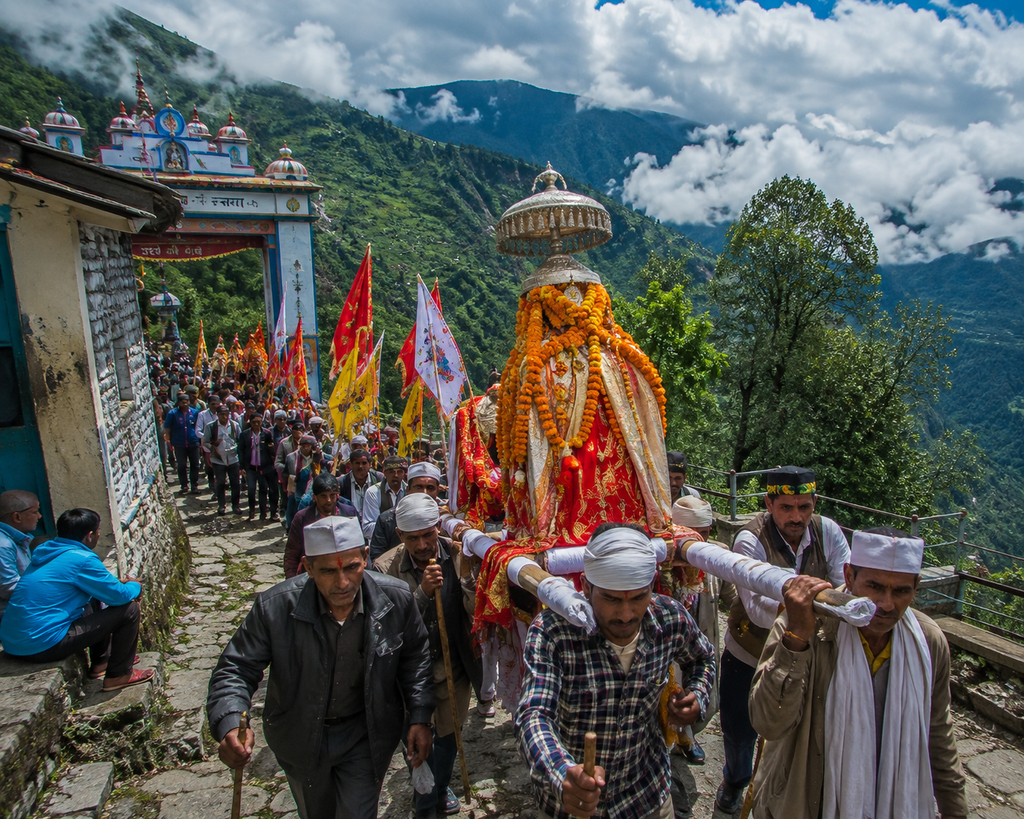
The journey of Maa Nanda does not remain limited to one village. From Nauti to Kansuwa, the Raj Jat moves forward through a landscape where every stop carries its own traditions, memories and beliefs.
Nauti holds a special place in the story of the Nanda Devi Raj Jat. It is from here that the journey takes its traditional form and begins moving towards the higher Himalayan regions. As the procession moves ahead, more people join it, and what began as a traditional farewell slowly takes the shape of a much larger collective journey.
Kansuwa is another important stop in this tradition. Its connection with the Raj Parivar (राजपरिवार) and the old customs of the Raj Jat gives the place a distinct position in the journey. The rituals and responsibilities associated with Kansuwa have been carried through generations, keeping an old connection between the people, the royal tradition and Maa Nanda alive.
For someone trying to Explore Uttarakhand beyond the usual tourist routes, this part of the journey reveals something different. This is not simply about travelling from one destination to another. It is about understanding the villages, people and traditions that make the mountains what they are.
The route from Nauti to Kansuwa is therefore an important part of these Uttarakhand Travel Stories. Along the way, the landscape changes, the crowds grow and the emotional weight of the journey becomes stronger. Every village that welcomes Maa Nanda adds its own voice to the farewell.
From Nauti to Homkund — Walking with Maa Nanda Towards the Himalayas…
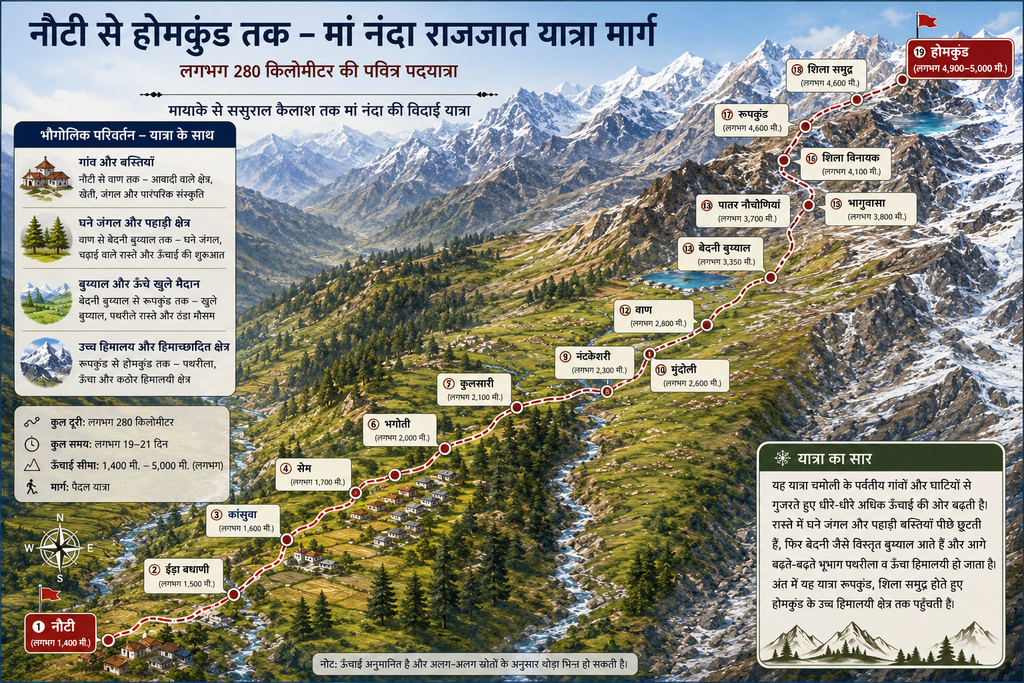
From Nauti to Homkund, the Nanda Devi Raj Jat gradually leaves behind the familiar villages and enters the higher Himalayan landscape. What begins as a traditional farewell in the settlements slowly turns into a demanding pilgrimage through forests, meadows, rocky trails and high-altitude mountain terrain.
The journey covers nearly 280 kilometres and traditionally takes around 19–21 days. Along the way, the landscape keeps changing. Villages and cultivated fields gradually give way to dense forests, open bugyals and finally the rugged, snow-covered surroundings of the higher Himalayas.
This changing landscape is one of the reasons the Nanda Devi Raj Jat feels so different from an ordinary Uttarakhand Tour. The route is not simply a line connecting two places; every stage has its own religious importance, local traditions and memories associated with Maa Nanda’s journey towards her maika (मायका).
As the procession moves higher, the journey becomes physically harder. The familiar roads disappear and the mountains begin to dominate the experience. For travellers interested in Uttarakhand Travel Stories, this route offers a glimpse of a side of Uttarakhand that cannot be understood through ordinary sightseeing alone.
The final stretches towards Homkund take the Raj Jat deep into the high Himalayas, making this one of the most challenging and spiritually significant parts of the journey.
Major Stops of the Raj Jat — Every Stop Has Its Own Story
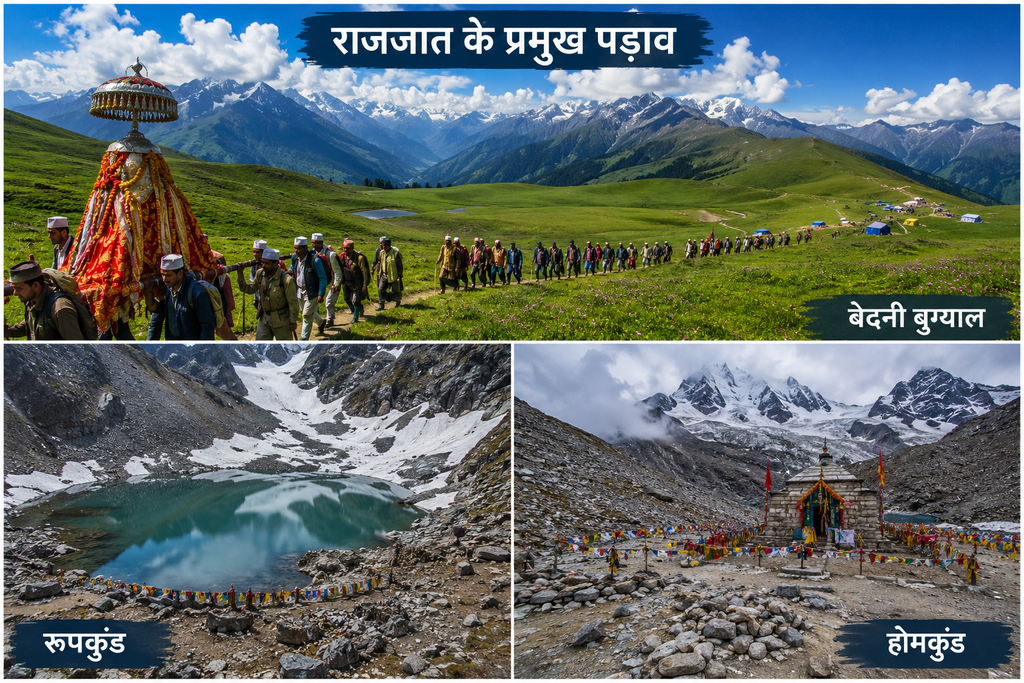
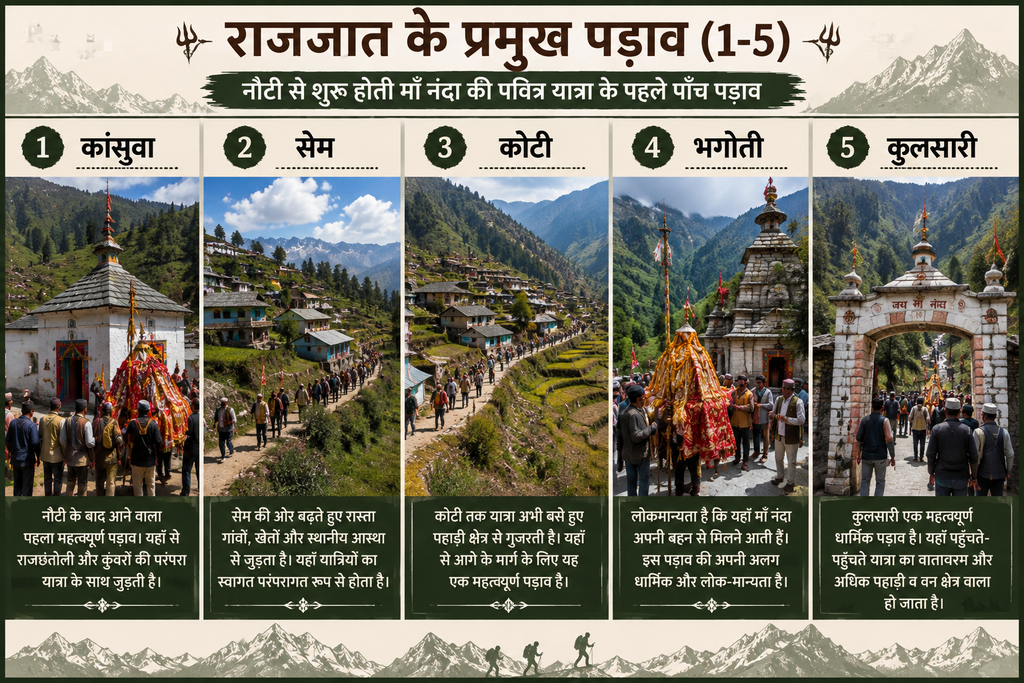
After leaving Nauti, the route of the Raj Jat is not measured only in kilometres. As the journey moves forward, the surroundings gradually change — from villages to forests, from forests to bugyals, and finally towards the high Himalayan terrain. Several important stops come along the traditional route, and each one carries its own religious, cultural or geographical significance.
1. Kansuwa
After Nauti, Kansuwa is an important stop of the Raj Jat. Its connection with the Kunwar tradition (कुंवर की परंपरा) and the Raj Royal Tradition (राजपरंपरा) makes it significant. This is where the traditional religious and royal character of the journey becomes clearly visible.
2. Sem
As the journey moves ahead from Sem, the procession passes through villages and mountain paths. Here, local faith and the tradition of welcoming the pilgrims continue to carry the journey forward.
3. Koti
Koti is an important stop in the early part of the journey. The route here still passes through inhabited mountain areas, with villages and cultivated fields visible along the way. It gives travellers a glimpse of the everyday landscape and rural life of Uttarakhand.
4. Bhagoti
Bhagoti is also connected with a local belief that Maa Nanda meets her sister here. Because of this tradition, the stop is not simply considered a place to rest; it also holds its own place in the folk beliefs surrounding the journey.
5. Kulsari
Kulsari is counted among the important religious stops of the Raj Jat. As the procession reaches here, the surroundings begin to feel increasingly mountainous and the forest landscape becomes more prominent.
For anyone interested in Uttarakhand Travel Stories, these stops help reveal how the Nanda Devi Raj Jat is connected not only with the Himalayas but also with villages, local traditions and the people who have kept this journey alive through generations.
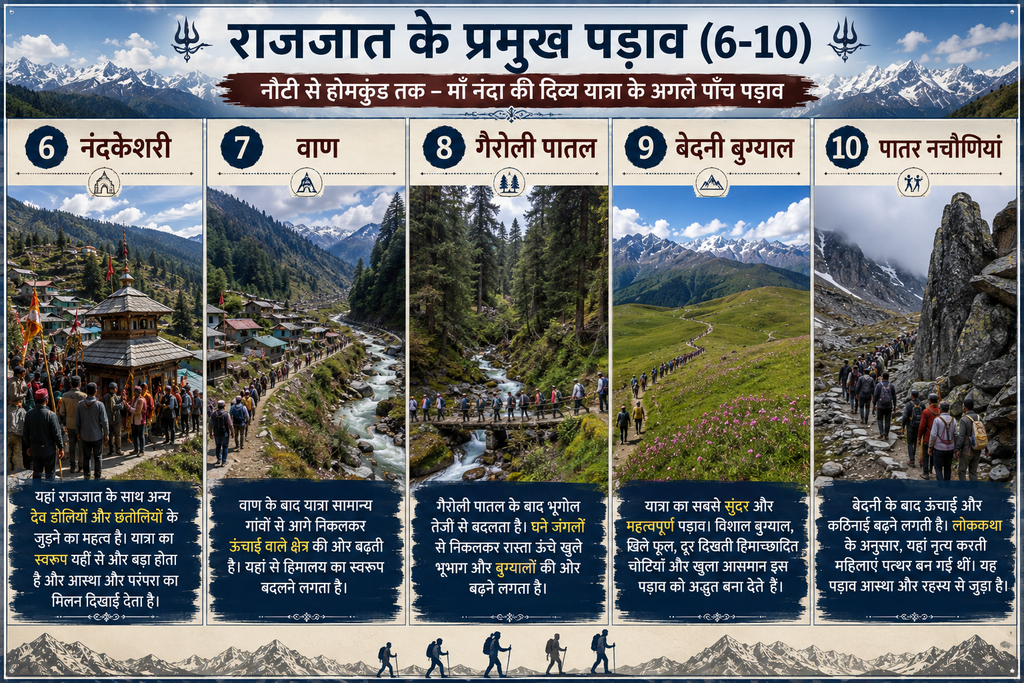
6. Nandkesari
Nandkesari is an important place where other Devi Dolis (देवी डोलियाँ) and Chhantoliyas (छंतोलियाँ) join the Raj Jat. With their arrival, the scale of the journey becomes larger and the traditional character of the pilgrimage becomes even more visible.
7. Waan
After Waan, the Raj Jat gradually begins moving towards higher terrain, where the usual mountain pathways start becoming less familiar. From here, the route continues towards areas covered with Himalayan forests and increasing elevation.
8. Gairoli Patal
After Gairoli Patal, the character of the journey changes noticeably. The route leaves the forested surroundings and moves towards open high-altitude bugyals (बुग्याल) and steeper mountain terrain.
9. Bedni Bugyal
One of the most beautiful and significant natural stops of the journey is Bedni Bugyal. The wide alpine meadow, distant Himalayan peaks and vast open sky create a landscape that feels completely different from the villages and forests crossed earlier.
For anyone interested in Explore Uttarakhand and Uttarakhand Travel Stories, Bedni Bugyal also shows how deeply the natural landscape is woven into the traditional Raj Jat route.
10. Paatar Nachauniya
After Bedni comes Paatar Nachauniya, where both the altitude and difficulty of the journey begin to increase. Local folklore associates this place with the story of women who are believed to have turned into stone while dancing.
11. Kaal Vinayak
Kaal Vinayak is an important sacred stop located at a high altitude on the Nanda Devi Raj Jaat Yatra route. From here, the trail becomes more difficult, rocky, and demanding. Before moving further toward the higher Himalayan region, pilgrims also consider this stop spiritually significant.
The journey through this section reflects both the physical challenge of the Himalayas and the deep faith that has kept the Nanda Devi Raj Jaat tradition alive for generations.
12. Roopkund
Roopkund is one of the most mysterious and well-known places along this Himalayan pilgrimage route. Situated at a high altitude, the lake is surrounded by dramatic mountain landscapes and is popularly known around the world as the Skeleton Lake because of the human remains found around it.
However, in the story of the Nanda Devi Raj Jaat Yatra, Roopkund is much more than a mysterious Himalayan lake. It represents one of the highest and most difficult sections of the pilgrimage, where the landscape becomes harsher and the journey demands greater physical and mental endurance.
13. Shila Samudra
After crossing the Roopkund region, the trail becomes even more rocky, remote, and distinctly Himalayan. Shila Samudra marks this transformation in the landscape.
The terrain here gives a completely different view of the high Himalayas—long stretches of rocks, steep slopes, and very little vegetation. Looking around from this point, the vast Himalayan landscape makes the scale and difficulty of the Nanda Devi Raj Jaat Yatra truly visible.
14. Homkund
And finally comes the place where the emotional journey of the Nanda Devi Raj Jaat Yatra reaches its highest point—Homkund.
Reaching Homkund is not simply about completing another stretch of the route. According to the tradition, this is the final and highest stage of the sacred journey, where Maa Nanda is symbolically accompanied toward her sasural, Kailash.
This is where the pilgrimage reaches its emotional climax. After travelling through villages, forests, alpine meadows and the high Himalayan terrain, the journey finally arrives at Homkund, carrying with it centuries of faith, tradition and the emotional story of a daughter bidding farewell to her maternal home.
2014 Raj Jaat – The Historic Yatra After 12 Years
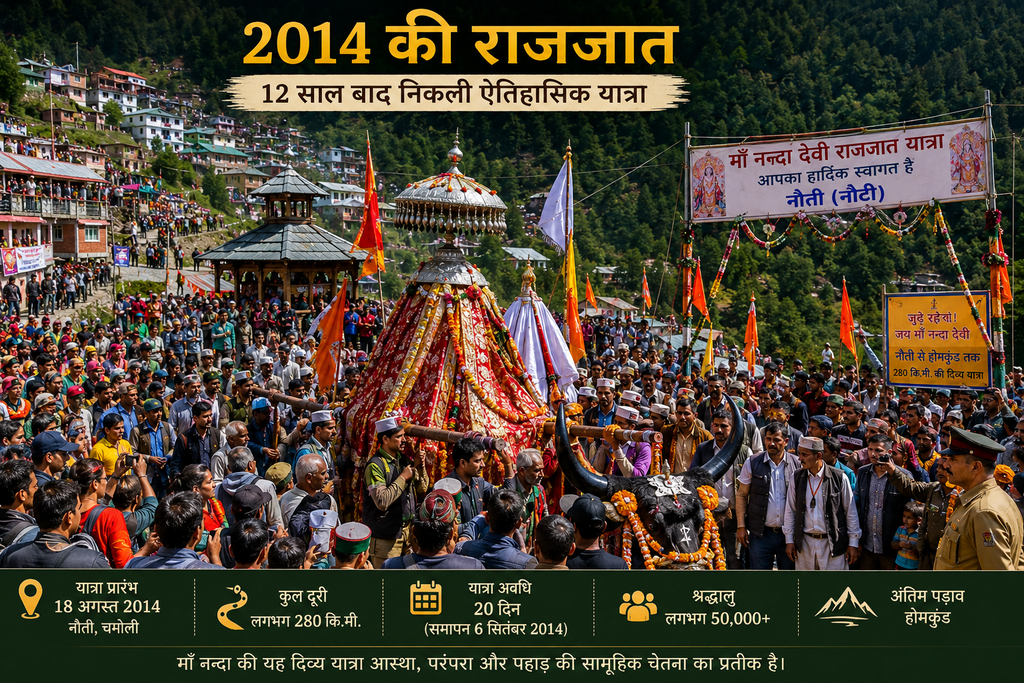
2014 holds a special place in the history of the Nanda Devi Raj Jaat Yatra. After the traditional 12-year gap, the sacred pilgrimage once again began its journey through the villages, forests and high Himalayan landscapes of Uttarakhand.
The return of the Raj Jaat after twelve years brought together thousands of pilgrims and devotees who walked with Maa Nanda, carrying forward an age-old tradition of faith, culture and devotion. For many people, it was not simply a religious journey but a deeply emotional experience connected with the traditions and identity of the Himalayan region.
The 2014 Raj Jaat became a memorable chapter in the continuing story of Maa Nanda Devi, bringing together generations of people and keeping the ancient pilgrimage tradition alive.
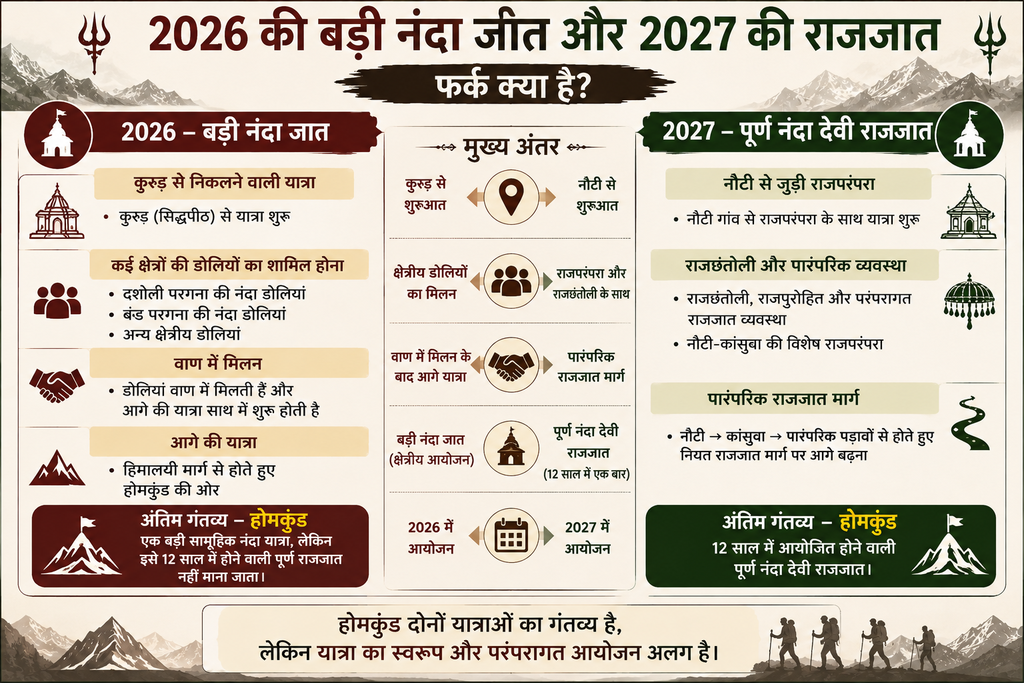
2026’s Badi Nanda Jaat and 2027’s Raj Jaat — What’s the Difference?
This is where the most confusion can happen. Although both the 2026 Nanda Jaat and 2027 Nanda Devi Raj Jaat are associated with Maa Nanda and the journey toward Homkund, they should not be understood as the same pilgrimage. The main difference lies in their form, scale, leadership, and traditional organization.
2026 — Badi Nanda Jaat
In 2026, a large Nanda Jaat is taking place, with doliya from different regions, including Dasholi Pargana and Khand Pargana, joining the journey. The procession moves toward Vaan, where the different dolis come together before continuing toward the higher Himalayan region.
So, the 2026 journey can be understood as a large regional gathering of Nanda dolis, bringing different local traditions together and eventually moving toward Homkund.
2027 — Full Nanda Devi Raj Jaat
The 2027 Nanda Devi Raj Jaat follows its traditional Raj Jaat structure. Its route and organization give special importance to places such as Nauti, Kansuwa, Rajbanshi and Rajparampara, along with the traditional Raj Jaat route toward Homkund.
At a meeting in Vaan, local representatives, temple committees and representatives of different padav committees have also expressed agreement toward organizing the Raj Jaat in 2027.
The easiest way to understand the difference is:
2026 — Badi Nanda Jaat
Regional Nanda dolis → Vaan → Doliyon ka Milan → Higher Himalayas → Homkund
2027 — Full Nanda Devi Raj Jaat
Nauti → Kansuwa → Rajbanshi & Rajparampara → Traditional Raj Jaat route → Homkund
Therefore, although Homkund may be the destination associated with both journeys, their identity and traditional structure are different. The 2026 Badi Nanda Jaat should not simply be described as the 12-year Raj Jaat.
The simplest distinction is this: 2026 brings together regional Nanda dolis as a large collective pilgrimage, while 2027 follows the traditional Raj Jaat tradition associated with Nauti and the Rajparampara.
Raj Jaat’s Difficult Route — How the Himalayas Change With Altitude
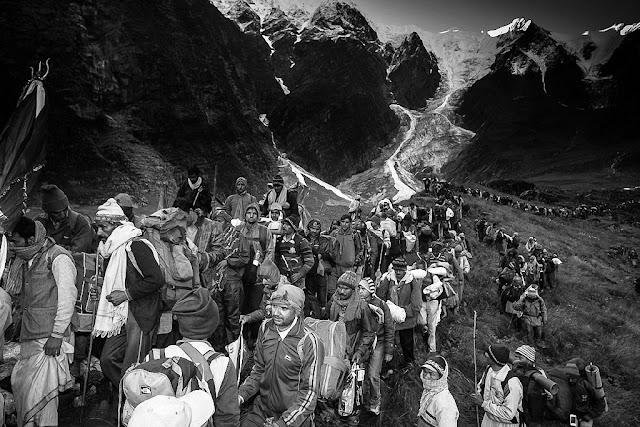
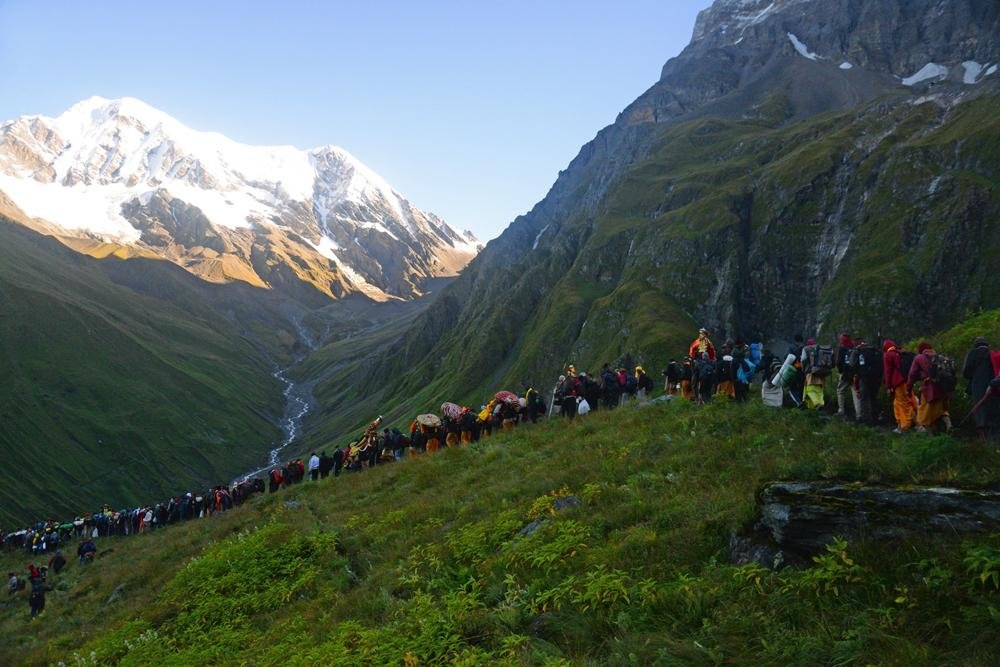
As the Nanda Devi Raj Jaat Yatra moves forward, the landscape gradually changes with the increasing altitude. In the beginning, the route passes through villages, fields and settlements, but after Vaan, the difficult and high-altitude Himalayan terrain begins to appear.
As the pilgrims approach Bedni Bugyal, the open alpine meadows, cold winds and increasing altitude become clearly noticeable. Beyond this point, the route toward Patar Nachauni, Kalu Vinayak and Roopkund becomes increasingly challenging and demanding.
The weather can also change quickly in these higher regions. Clear skies can suddenly turn cloudy, while cold winds may begin to blow even during the day. Facilities along the route are limited, making preparation and faith equally important for those undertaking this difficult Himalayan pilgrimage.
What Should You Carry for the Nanda Devi Raj Jaat Yatra?
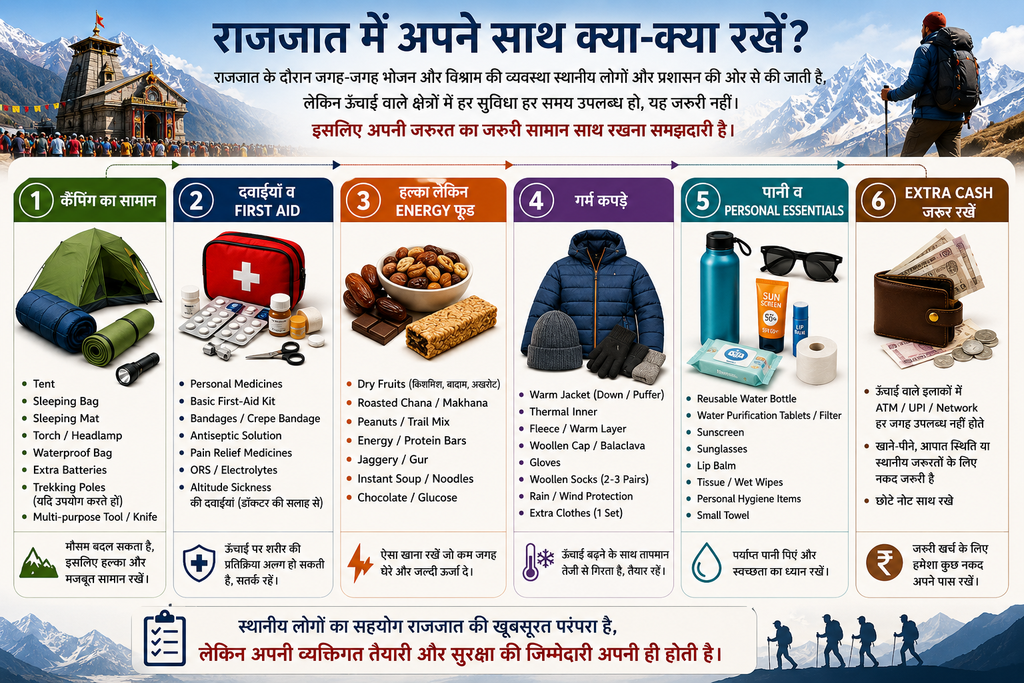
The Nanda Devi Raj Jaat Yatra is not an ordinary trek. As the route moves from villages and forests toward high-altitude Himalayan terrain, proper preparation becomes important. The weather can change quickly, the trail can become difficult, and basic facilities may be limited in the higher sections.
If you are planning to experience this Himalayan pilgrimage, your packing should focus on warm clothing, trekking essentials, medicines, food, water and personal safety rather than carrying unnecessary weight.
Warm & Weatherproof Clothing
Carry thermal layers, warm fleece or woollen clothes, a good insulated jacket, waterproof rain gear, woollen socks, gloves and a warm cap. Waterproof trekking shoes are especially important because the trail can become wet, muddy and slippery.
Medicines & First-Aid
Keep your regular medicines, a basic first-aid kit, bandages, antiseptic, ORS or electrolytes and basic blister-care supplies. At high altitude, even a small health issue can become difficult to manage, so preparation matters.
Light Energy-Giving Food
Although food arrangements may be available at different points, carrying lightweight snacks such as dry fruits, roasted chana, dates, energy bars and other quick-energy food can be useful during long walking sections.
Water & Personal Essentials
A reusable water bottle, sunscreen, sunglasses, lip balm, tissues or wet wipes and basic personal-hygiene items should also be part of your backpack. Staying hydrated becomes especially important as the altitude increases.
Most importantly, pack according to the route and weather rather than carrying unnecessary things. The Nanda Devi Raj Jaat is a long Himalayan journey where preparation, patience and respect for the mountains matter as much as physical fitness.
In the End — Maa Nanda’s Farewell and Chaunsinghya Khadu’s Solitary Journey
Perhaps the best way to understand the Nanda Devi Raj Jaat Yatra is to return to the same emotion with which it began — the farewell of a daughter.
Maa Nanda is considered the daughter of the mountains. When her doli leaves her maternal home and begins its journey toward Kailash, it is not simply a religious pilgrimage. Villagers, women, elders, children and thousands of devotees come together to bid farewell to their daughter. They walk alongside her, serve her and wait for the moment when she finally moves toward her sasural in Kailash.
But the story of Chaunsinghya Khadu makes this farewell even more emotional.
According to tradition, the four-horned ram walks alongside Maa Nanda as her companion and eventually leaves with her toward Kailash beyond Homkund. From a distance, it may look like an animal being taken along the pilgrimage, but within the tradition it carries a much deeper meaning. It represents the final companion who accompanies Maa Nanda on her difficult journey into the high Himalayas.
This is where faith and emotion come together.
It is believed that Maa Nanda takes Chaunsinghya Khadu with her and that the animal receives the protection of Bholenath. Perhaps this is why thousands of people do not see its final journey as that of an ordinary animal, but as a sacred companion travelling with Maa Nanda toward Kailash.
Yet one question remains — does our responsibility end with tradition?
Faith has its place, but so does compassion toward every living being. Therefore, while understanding the tradition of the Nanda Devi Raj Jaat, we should also look at every part of it with respect, sensitivity and responsibility.
Because in the end, the Raj Jaat does not only teach us about Maa Nanda’s farewell. It also teaches us about the culture of the Himalayas, the faith of its people, the beauty of nature and our responsibility toward the living beings that form a part of this tradition.
Sources, Support & Special Thanks
While preparing this article, we continuously referred to information, stories and references related to the culture, traditions and pilgrimage practices of Uttarakhand.
A special mention goes to Neeraj Daa (@iamneerajpant) for his work through content related to Uttarakhand’s culture, traditions and villages, and for helping people connect with the heritage of the mountains.
Keywords naturally used: Nanda Devi Raj Jaat Yatra, Nanda Devi Raj Jaat, Maa Nanda, Uttarakhand, Kailash, Homkund, Chaunsinghya Khadu, Himalayan pilgrimage, Himalayan culture.
Stay Connected with DK Travel Diary
If you love discovering real stories, local culture, traditions, and hidden places of Uttarakhand, make sure to follow DK Travel Diary on Instagram and Facebook.
If you want to explore Uttarakhand’s lesser-known villages, hidden places, and local culture beyond the usual tourist destinations, you can join us on this journey.
Our journey is not just about reaching places — it’s about understanding the stories hidden behind them.
DK Travel Diary — Explore Uttarakhand, Beyond the Tourist Trail.